Walk into a red-walled restaurant and you might feel hungrier than you expected. Step into a pale blue office and your shoulders drop slightly. These aren't coincidences.
Color psychology is the study of how colors affect human perception, mood, and behavior. It's a field that draws on neuroscience, design, and behavioral research to explain why a yellow warning sign works, why hospitals favor soft greens, and why so many tech companies defaulted to blue in their early branding phases.
The effects aren't fixed or universal, though. Context shapes everything, and so does culture. Red signals danger in one setting and celebration in another. What feels calming in a Scandinavian living room might read as cold in a Brazilian marketplace. Any honest account of this field has to hold both truths at once.
This article moves through the core mechanisms behind color perception, the meanings commonly associated with specific colors, practical applications across marketing, design, and everyday environments, and the real limitations that keep color psychology from being a simple formula.
What Color Psychology Really Means
Red action tags evoke a sense of urgency in a sale. That's no coincidence - they are probably a result of what color psychology experts call "color psychology", i.e., how color impacts our perception, emotions, and behavior.
The term "perception" here is how your brain decodes visual information immediately without any cognitive processing. Arousal, meanwhile, is how awake or active you feel with a color confronting you; red and orange tend to spark it while blue and green bring it down. Cultural connections refer to those the group gives a color over time through tradition, religion, or media exposure.
No single effect operates independently from the others. An individual's response to any particular color is the product of three interconnected sources: biology, learned behavior, and social context. Biologically, warm tones like red and yellow activate the nervous system in ways that cool tones do not. The rest is shaped by learned behavior. Some children raised seeing red stop signs and warning labels will carry that meaning all their lives. Finally, context overrides everything. A yellow color on a hazard sign will indicate caution but the same bright yellow on a sunflower would mean warmth.
How Individual Colors Influence Meaning and Response
Each color carries a kind of psychological weight, shaped by biology, culture, and repeated exposure. Understanding what that weight feels like in practice is what separates thoughtful design from guesswork.

Red
Physiologically, red raises heart rate and increases arousal - which is exactly why it dominates fast food branding and clearance sale signs. It signals urgency and appetite. Deep crimson reads as luxurious or dangerous, while a bright fire-engine red feels immediate and loud. The difference in shade matters more than most people expect.

Blue
Trust and calm are blue's most reliable associations. Banks and tech companies lean on it heavily - think of how many financial apps default to navy or sky blue. Lighter blues feel open and airy; darker ones project authority. It's one of the few colors that works across almost every professional context without much risk.
Yellow
Optimism is yellow's calling card, but it's also the most visually fatiguing color at high saturation. Babies cry more in yellow rooms, according to some interior design research. Used sparingly, it draws the eye and signals warmth. Overused, it becomes overwhelming fast.
Green
Health, nature, and financial prosperity all cluster around green. Pharmacies and organic food brands use it to signal safety and wellbeing. Muted olive greens feel earthy and calm; bright greens feel energetic and modern. It's one of the easiest colors for the human eye to process.

Orange
Orange combines the intensity of red with the optimism of yellow, which makes it naturally attention-grabbing without feeling aggressive. It is often used in call-to-action elements, especially in digital interfaces where visibility and urgency matter. Brands targeting younger audiences or promoting energy, movement, and affordability tend to rely on orange to create a sense of approachability.
At the same time, orange can become overwhelming if overused. In more formal or institutional environments, it may feel too informal or even distracting. Its effectiveness depends on balance, often working best as an accent rather than a dominant background color.

Purple
Purple carries long-standing associations with royalty, luxury, and creativity. Historically linked to wealth due to the rarity of purple dyes, it continues to signal premium positioning in modern branding. It is widely used in beauty, cosmetics, and specialty food products, where it helps communicate uniqueness and refinement.
Beyond luxury, purple also has a creative and slightly mysterious edge. Lighter shades like lavender feel calming and imaginative, while deeper tones suggest richness and exclusivity. However, in some contexts, it may feel overly stylized or niche if not aligned with the brand’s identity.
Black
Black is one of the most versatile colors in design, often associated with sophistication, authority, and modernity. It is frequently used in luxury branding, fashion, and technology to convey a sense of control and confidence. When paired with minimal layouts, it enhances clarity and focus.
However, black can also feel heavy or intimidating in certain settings. In healthcare or educational environments, it may create a sense of distance or severity. Its impact depends heavily on contrast and context, often working best when balanced with lighter tones.
White
White is commonly associated with simplicity, cleanliness, and clarity. In design, it creates space and improves readability, making it a foundation for minimal and modern aesthetics. It is widely used in both healthcare settings and luxury retail, though the emotional interpretation differs significantly.
In medical environments, white can feel sterile and clinical, reinforcing a sense of hygiene and control. In contrast, in retail or branding, it communicates elegance and restraint. The same color can therefore feel either comforting or distant, depending on how it is framed and combined with other elements.

Pink
Pink is closely linked to softness, care, and emotional warmth, particularly in its lighter tones. Soft pinks are often used in wellness, skincare, and lifestyle branding to create a calming and nurturing atmosphere. These tones can make a space or product feel approachable and gentle.
Brighter variations, such as hot pink, shift the perception entirely. They introduce energy, boldness, and playfulness, often used to stand out or challenge traditional expectations. Because of this range, pink is highly flexible but requires careful tone selection to match the intended message.
Why Context, Culture, and Contrast Matter So Much
In the West, white is a sign of purity and new beginnings, and it is a sucker punch signifying death in much of Asia. So the color signifies two opposite meanings. From a social angle, should let any designer or advertiser pause with the assumption that color works the same way in any area.
Culture Changes Everything
Green offers another clear example. In many Western markets, it reads as natural, healthy, and eco-conscious. In some parts of the Middle East, it carries deep religious significance, associated with Islam and spiritual authority. In Indonesia, it has historically been avoided in commercial packaging due to associations with illness. No color arrives culturally neutral.
Age and personal experience add another layer. Research by psychologist Andrew Elliot suggests that color-emotion links are partly learned rather than hardwired, meaning someone who grew up associating yellow with caution signs will respond differently to a yellow logo than someone who associates it with sunflowers and summer.
Contrast, Brightness, and Pairing Change the Signal
A single color never really exists alone. Place red next to black and it feels aggressive, even dangerous. Pair the same red with soft cream and it reads as warm, romantic, almost vintage. Brightness matters too. A muted, dusty blue suggests calm professionalism. Crank up the saturation and it starts to feel sporty or urgent.
Industry norms shape perception as well. Pharmaceutical companies default to clean blues and whites because those combinations have built decades of trust. A fintech startup that copies the same palette might feel credible or just generic, depending on everything surrounding it.
Treating Color Psychology as a Guide, Not a Formula
There's no denying the research is real and the patterns are consistent enough to be useful. But color psychology works best when treated as a probability, not a rule. Context, culture, and composition all vote. The color is just one voice in that conversation.
Using Color Strategically in Marketing, Design, Education, and Everyday Spaces
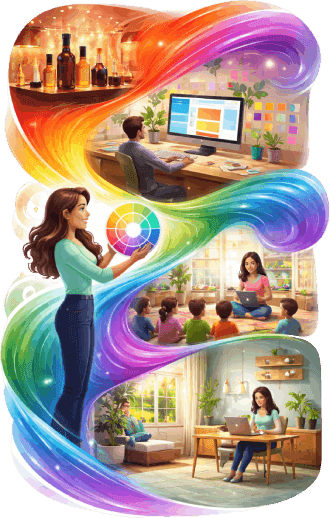
Understanding the psychology of colors is one thing but their proper application has always been rather a challenge.
Marketing and Brand Positioning
Marketers have long understood that color signals value before a single word is read. Black and gold packaging reads as premium almost automatically. Bright red creates urgency, which is why clearance tags and limited-time banners lean on it so heavily. Blue dominates financial services and healthcare because it communicates stability and trust - think PayPal, Chase, and most hospital signage. The choice isn't about what looks nice. It's about what response you're trying to generate in the person looking at it.
Audience matters as much as intention. A brand targeting young children needs a completely different palette than one selling legal software to corporate buyers. Before choosing colors, ask who you're actually speaking to and what you need them to feel within the first three seconds.
UX and Graphic Design
Attention is a limited resource, and color is one of the fastest ways to direct it. High-contrast call-to-action buttons - orange on white, for example - consistently outperform low-contrast alternatives in click-through testing. Accessibility can't be an afterthought here. Roughly 8% of men have some form of color vision deficiency, so relying on red versus green alone to signal error or success will fail a significant share of your users. Tools like the WCAG contrast ratio guidelines exist for exactly this reason.
Workplaces, Classrooms, and Home Offices
Environment shapes behavior more than most people realize. Studies from color researchers like Frank Mahnke suggest that blue-green tones support sustained concentration, while warm yellows can lift mood in spaces prone to low energy. Classrooms for younger children often benefit from moderate color variety, while spaces designed for deep focus - writing rooms, therapy offices - tend toward softer, cooler neutrals.
At home, the principle is simple: match the color to the activity the room is built for, not the trend you saw last month.
Color Works Best When You Use It Intentionally
Color choices that are made send a signal as well - whether that message is conveyed intentionally or not. Thus, in essence, what we have gone into in this brief article is the realization that color affects people in the way they feel, what they see or fail to see with these eyes, and what they do or do not decide, always depending on the contexts and cultural background and how cleverly the designer uses that color. Red can excite, or signal danger. Blue can soothe or distance its user. Green can ease or bore. In the end, the outcome is directly a result of context, culture, and intent. Knowledge of such conventional associations could provide a basic guide, but it is not the be-all and end-all formula. What really works is understanding how your particular target audience relates to color, challenging your assumptions, and not selecting color simply because you like it. Whether this premise applies to a product label, choosing a classroom wall color, or creating a brand identity, the principle is the same: allow the evidence and the audience lead the way on palette selection, not your gut instinct.