
It is rare when the color is modified by chance. The palettes used to define fashion lines, product release, interior, and web interfaces are often an intensively researched and deciphered result. Color forecasting and trend analysis provide an avenue, whereby one can establish the way tastes and preferences vary and the response of the industries to the cultural, technological, and emotional shifts.
Color forecasting is all about anticipation and not prediction. It does not focus on informing the consumers about what they will like, but only indicates signs that lead to the new directions. Observation, collaboration and analysis is through which the forecasters translate these signals into palettes that are applied in creative and commercial decision-making in industries
Prediction of the Meaning and Purpose of Color
Color forecasting describes the art of observing the new forces of color preferences over time. It consists of the collection of visual, cultural and other behavioral data and translating them into palettes and these could be used by designers and manufacturers in order to inform future collections and products.
Aesthetic coordination is not the only type of forecasting. Color is a strategic element of building brand image, experiencing emotions and assists in identification in the market. Being aware of the direction in which the flow of colors is moving, will help the industries to reduce the risk of working in a way, which will contradict the expectations of the consumers and create more integrated stories of designs.
The History of Colour Trend Research
Color trend research has evolved into a research-oriented collaborative discipline out of an intuitive practice. The demands of global industries to coordinate both color directions grew with their growth, which stimulated the development of forecasting organizations and common approaches.
The color direction was traditionally highly reliant on the intuition of the designers and the craftspeople. The individual taste and the regional tradition and accessible materials were used in the choice of color without any research. With the expanding industries, and the world markets becoming closer together, it was obviously obvious that unified color direction was in need.
Planned forecasting came up in the twentieth century. The design consultancies, organizations and industry groups began to merge in order to read the trends and publish a seasonal palette. Such a twist turned the color forecasting process into a less subjective and more a strategic field, which could be assisted by research and argument in the industry.
Globalization increased the pace of exchanging visual culture in which trends moved across boundaries at an extremely high rate. The international fashion weeks as well as the trade fairs and online media have helped to lay standard reference points among the fashion designers around the world. This led to the increased alignment towards the direction of colors and the industries were also likely to use similar colors depending on the global narratives.
Whereas this interconnectedness is a fact, regional interpretation does count. The cultural context, climatic conditions and local identity still adapt and manifest global palettes.
Remarkable Constructors that Venerate Color Trends
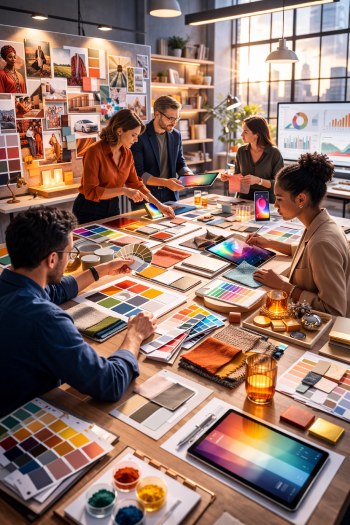
The cultural, technical and economical variables interact as the trend development of colors is a complex process. Industries have such values that define functional value of color and emotional color value. Since it is known about these effects, the forecasters can predict small oscillations before it grows and becomes rather remarkable.
Cultural and Social Influences
Colour is an image of the mood in the society. Dark and relaxing colors can be applied in the moments when a person is not sure and vice versa, a bright set of colors can be drawn in the situations when everything is alright. The changes in the perception of colors are caused by the social movements, generation attitudes, and the changes in the lifestyle.
It also possesses cultural narration. Heritage, identity, and common memory are represented by colors that can be reused again as an indicator of nostalgia or empowerment and influence design in any industry.
Technological and Industrial Innovation
The color has been brought out by the innovation of technology. Colors and effects that were not easy to accomplish in the past are made possible due to new pigments, digital displays, and finishes of materials. The advancements in the production processes can also be used to determine colour choice, longevity and sustainability.
The world of the internet has been a victim to a large extent. The interface design can be put to work with regard to the screen-mediated interaction and accessibility in creating a new color relation based on the virtual space and the immersive media.
Market Forces and Economics
The economic conditions tend to influence consumer appetite of color. The wave of popularity of experimental palettes may be timed with a period of stability, and economic turmoil may provide a boost to pure and classic colors that may be seen as safer.
Competition between brands is also a reason for trend adoption. Businesses are keen on colors, which will enable products to shine and at the same time attract the larger cultural movement, locating the middle ground between originality and marketability.
The Color Forecasting Process
The forecasting procedure transforms the diffuse observation into useful insight. It is a teamwork and repetitive process that entails research, interpretation, and communication. At every step there is the conversion of inspiration to real design advice.
Research and Data Collection: The process of forecasting is initiated by observation. Visual references are collected by forecasters in various sources such as art, fashion, architecture, technology, retail spaces and digital culture. The social media imagery, street style, and consumer behavior can be a good source of information about the new preferences. Digital analytics have been increasingly applied in data collection. Qualitative observations are supported quantitatively by online search trends, buying data, and tracking visual trends.
Interpretation and Development of Theme: After the gathering of signals, forecasters interpret them with the help of narrative frameworks. Color direction can be contextualized with the use of theme or mood stories, which link palettes to more general cultural and emotional stories. This is the step of perfecting raw inspiration into harmonious color schemes that convey a definite design message. Application is also taken into consideration in theme development. Colors should be able to work on a variety of materials, on lighting situations and on different types of products, and they have to be evaluated on the basis of versatility and utility.
Tools and Methods Used in Trend Analysis
Color forecasting combines creative exploration with analytical tools. Common methods include:
- Visual research and mood boards to organize inspiration
- Consumer insight platforms that track behavioral patterns
- Retail and runway analysis to identify emerging themes
- Digital color libraries and software for palette development
- Collaborative workshops that encourage interdisciplinary discussion
These tools support both intuitive and data-driven decision-making, reinforcing the hybrid nature of forecasting as a practice rooted in observation and interpretation.
Color Forecasting Across Major Industries
Color forecasting influences a wide range of industries, each with unique timelines and priorities. While the underlying research may overlap, application varies depending on product life cycles, material constraints, and consumer expectations.
Fashion and Textiles
Fashion remains one of the most visible arenas for color forecasting. Seasonal collections operate on rapid cycles, making accurate trend analysis essential. Forecast palettes guide fabric development, dye production, and merchandising strategies, ensuring visual cohesion across brands and markets.
Interior Design and Architecture
Interior and architectural trends typically evolve more slowly than fashion. Color direction in these fields reflects lifestyle aspirations, spatial psychology, and long-term investment considerations. Forecasts often emphasize adaptability and emotional resonance, supporting environments that balance novelty with longevity.
Product and Industrial Design
In product design, color influences perceived value, usability, and brand identity. Material innovation and manufacturing constraints play a significant role in determining which colors are feasible. Forecasting helps designers anticipate consumer expectations while maintaining functional performance.
Digital Media and Branding
Digital environments introduce unique considerations such as screen calibration, accessibility, and cross-platform consistency. Branding strategies increasingly rely on adaptable color systems that function across physical and digital touchpoints. Forecasting supports the development of palettes that feel contemporary while maintaining recognizability.
The Role of Consumer Psychology in Color Trends
Perception of colour is closely associated with emotion and cognition. The interpretation of products, spaces, and visual communication by the consumers is affected by psychological associations. As an example, warm colors can produce a feeling of comfort or activity whereas cool colors can produce a feeling of calm or clarity.
The trend cycles have a repetitive role of nostalgia. The colors related to previous decades often reappear and are transformed by modern situations. This cyclical aspect is associated with human needs to pursue familiarity and adopt novelty.
The color preference is also influenced by the generational differences. The generation and the older demographics might be attracted to older palettes that are based on reliability and refinement, and the younger audience might be attracted to newer palettes that are based on experimentation and digital culture.
Challenges and Limitations in Predicting Trends of Colours
Color forecasting is not without its challenging sides despite its systematic approach. A change in culture might happen within a short time, and thus forecasts can hardly be done on a long-term basis. Last minute world events or technological advances or social movements can change the color perception in a manner that is not easily predictable.
There is the problem of over-forecasting. Trends may lose their focus when many palettes are competing and this causes consumer fatigue. It is a major challenge for forecasters to maintain their balance between originality and practicality.
Adoption is also affected by commercial constraints. Forecasts can be implemented differently based on the manufacturing constraints, cost and regional tastes, and the trend frameworks should be flexible.
Future of Color Forecasting
The trends of color forecasting are a reflection of the wider technological, cultural, and consumer trends. The new tools and changing communication platforms are redefining the way that trends are spotted and deciphered, providing new ways to innovate.
Predictive analytics and Artificial Intelligence
Trend analysis is changing with the progress in artificial intelligence. Machine learning has the ability to draw visual patterns from large data, producing new knowledge on new relationships between colors. The predictive analytics will improve the ability to monitor micro-trends and predict consumer behavior changes.
Hyper-Personalization and Micro-Trends
Niche communities can dictate the color direction through digital platforms which have given birth to micro-trends. Custom feeds and algorithm feeds introduce the user to the extremely narrowest palette, diversifying the color preference realms.
This fragmentation is disruptive to the conventional forecasting models but it provides potential to more focused design strategies.
The Human and Technological Intelligence
Human interpretation is critical despite the fact that technology has advanced. Creative intuition, emotional intelligence, and cultural awareness give background to information that cannot be transmitted through an exclusive data source.
The future of forecasting includes the assimilation of analytical technologies with human intuition, which will help build a general perception of the development of colors.
Why Color Forecasting Is More Intense than Ever
Color forecasting and trend analysis are used as conduits among culture, imagination and business. Forecasters assist industries to navigate in a constantly evolving visual environment by analyzing the emerging impacts and converting them into unified palettes.
The role of forecasting is increasing as globalization, digitalization, and sustainability keep reforming the priorities of design. It helps brands and designers to react intelligently to cultural changes without losing creative genuineness.
Finally, color forecasting does not predict a definite future but it only interprets possibilities. It provides a platform of perception when it comes to the relationships between color and human experience and how businesses can utilize that perception to generate meaningful and resonant design.