There is no thing as powerful in the universe as colour. We have all watched a black and white television and know how bland the experience felt. In fact, the inability to see color is a medical ailment.
Color brings beauty and depth to everything around us. It has a great effect on what we buy, think and feel. We see it everywhere around us. However, despite this level of familiarity, colour is actually more complex than you think. It is the product of a combination of maths, biology, physics and culture. Light lands on an object, the color travels to our eye and our brain interprets the signal.
Can we see enough reasons why we should study color? Simply put, color matters across several fields. Scientists need to describe what they observe. Artists rely on color theory to evoke emotion and visual harmony. Manufacturers must ensure that a product's color looks identical whether it is viewed on a screen, printed on packaging, or applied as a coat of paint.
Branding experts understand that it's necessary for brand recognition which directly affects brand equity. If there's no standardized understanding of color, communication between these worlds would collapse into guesswork.
As you read on, you'll learn how to study and understand color. Starting from its scientific roots, through the classification systems that make it measurable, and the professional applications that touch almost every industry in the modern world.
Physics: Light and the Visible Spectrum
From the perspective of a physicist. color is actually light. Visible light lies somewhere along the middle of the electromagnetic radiation, spanning wavelengths from approximately 380 nanometers (violet) to 700 nanometers (red).
The main colors include Red, Orange, Yellow, Green, Blue, Indigo and Violet. The absorption and reflection of various wavelengths is a constant occurrence when light hits a surface. Whatever wavelength gets to our eye is the color of the object. For example, a vegetable will appear green because it reflects wavelengths in the green zone and absorbs others.
Light also behaves differently depending on whether it is being combined (additive mixing) or filtered through pigments (subtractive mixing). In additive mixing, used in screens and stage lighting, combining red, green, and blue light produces white.
In subtractive mixing, used in printing and painting, combining cyan, magenta, and yellow absorbs more wavelengths, producing darker colors and eventually black. Understanding this distinction is foundational to any professional work involving color.
Physiology: Human Visual Processing
We have discussed the physics aspect of light. Let's go into biology and physiology to see what happens under the hood in your body when light strikes your eye. There are two sets of photoreceptors located in the retina which are called rods and cones. Rods are meant for black and white vision while cones are for color vision.
There are three types of cone cells, each most sensitive to different parts of the spectrum: short (S) cones respond to blue-violet light, medium (M) cones to green, and long (L) cones to red-orange. Crucially, what we experience as color isn't a direct readout of wavelengths; it's an interpretation constructed by the brain.
This is why two people can look at the same object and describe its color slightly differently, and why optical illusions involving color can fool even careful observers. Color perception is inherently subjective, which is why standardized systems for measuring and communicating color are so important.
Psychology: Early Scientific Discoveries
The scientific study of color as a discipline is often traced back to Isaac Newton. In 1666, Newton passed sunlight through a glass prism and demonstrated that white light is not pure but is composed of all the colors of the visible spectrum.
This was a revolutionary finding: it showed that color was not added to light by objects, but was an intrinsic property of light itself. Newton's work laid the conceptual groundwork for the centuries of research that followed.
Core Dimensions Used to Classify Color
To describe a color precisely, professionals rely on three core dimensions, hue, value, and chroma that together capture virtually any color a human can perceive. These dimensions form a three-axis model that embraces both artistic color theory and scientific color measurement.
Hue refers to the color family a color belongs to: red, yellow, green, blue, and so on. It is what most people mean when they casually name a color. Value, sometimes called lightness, describes how light or dark a color is on a scale from black to white.
A deep navy and a pale sky blue share the same hue but differ dramatically in value. Chroma, often called saturation, measures how pure or vivid a color is. A fire-engine red has very high chroma, while a dusty rose has low chroma despite belonging to the same hue family.
These three dimensions were formalized into a practical color system by American painter and art educator Albert Munsell in the early twentieth century. The Munsell Color System arranges colors on a three-dimensional sphere, allowing anyone to specify a color using a simple notation. This system remains influential today and directly inspired many of the digital and scientific color models that followed.
Major Color Systems and Models
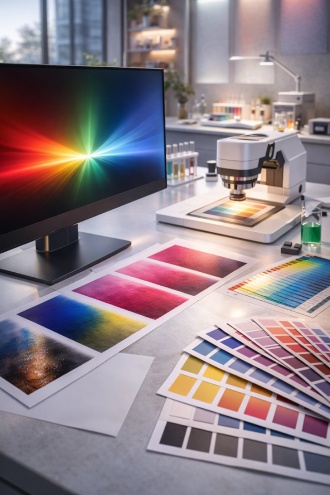
Over the years, no single color model has sufficiently proven to work for every application. Different industries then responded by developing systems optimized for their specific medium, whether that is a glowing screen, an inkjet printer, or an industrial paint line.
Digital Models: RGB
The RGB (Red, Green, Blue) model is the backbone of digital color. Screens produce color by combining red, green, and blue light at varying intensities. Each channel can range from 0 (off) to 255 (full brightness), which gives over 16 million possible combinations — enough to render virtually any color the human eye can perceive. Every image you view on a phone, monitor, or television is built from this additive system.
Print Models: CMYK
When color moves from screen to paper, the model must change. Printing uses the CMYK system: Cyan, Magenta, Yellow, and Key (black). This is a subtractive model where inks absorb certain wavelengths and reflect others.
Black ink is added as a separate channel because combining CMY inks theoretically produces black, but in practice, it yields a muddy brown, and pure black is essential for text and fine detail. Understanding the difference between RGB and CMYK is a fundamental skill for any designer preparing work for print.
Scientific Measurement: CIE Color Spaces
For science and engineering, neither RGB nor CMYK is precise enough, because they are device-dependent. This means the same RGB values can look different on two different screens.
The International Commission on Illumination (known by its French acronym CIE) developed a series of device-independent color spaces, most notably CIE XYZ and its derivative CIELAB, which define colors based on human perception rather than any particular device. These models allow accurate color communication across labs, factories, and borders.
Commercial Standards: Pantone
There are industries where exact color consistency is non-negotiable; fields such as brand logos, automotive finishes, or consumer packaging. For them, the Pantone Matching System (PMS) provides a universal language. The Pantone company created its name by merging the word "Pan" (All) with the word "Tone" (Color).
Each Pantone color is assigned a unique code and corresponds to a precisely formulated ink or pigment. A designer in New York can specify Pantone 485 C, and a manufacturer in South Korea will produce the exact same red. This global consistency makes Pantone indispensable in manufacturing and branding.
Methods Used to Study Color Professionally
Professionals across design, art, and manufacturing study color through a combination of scientific measurement, psychological analysis, and artistic, structured experimentation. Here are the most common methods used to study color to ensure accuracy and consistency.
Instrumental Measurement
Studying color professionally almost always begins with measurement. Spectrophotometers are the gold standard instrument: they measure how much light a surface reflects at each wavelength across the visible spectrum, producing a detailed spectral curve that uniquely fingerprints a color.
Colorimeters offer a simpler, faster alternative, measuring color in terms of the three cone responses of the human eye. Both instruments require careful calibration against known reference standards to ensure accuracy and consistency across sessions and locations.
Experimental Research
Alongside instrumental measurement, color science relies heavily on carefully controlled human vision experiments. Researchers design tests where participants evaluate color matches, judge contrast, or identify the boundaries between color categories.
These experiments reveal how perception varies with lighting conditions, background colors, and viewing angles—insights that instruments alone cannot capture. For example, studies on simultaneous contrast have demonstrated that the same color appears lighter or darker depending on what surrounds it, a finding with enormous implications for design and signage.
Data Analysis Approaches
Each human is very distinct; therefore, color perception varies among individuals, either due to genetics, age, or conditions like color blindness. Color researchers use statistical modeling to identify consistent patterns across populations.
Cross-observer reliability testing ensures that a color standard holds up not just for one type of viewer but for the broad range of people who will actually encounter it. These quantitative approaches transform inherently subjective perception into reliable, reproducible data.
Professional Applications of Color Study
Here are some of the key fields where color plays a key role in art, architecture, fashion, and various fields. Let's look at significantly impacts communication by influencing perception and emotions, evoking specific responses, conveying information, and enhancing user experience
Design Fields
Graphic designers, fashion designers, and interior designers all depend on a structured understanding of color to create work that communicates effectively and feels visually balanced.
For instance, the principle of color harmony guides the combinations of hues and explains how complementary colors directly opposite each other on the color wheel are naturally pleasing to the eye. Professional designers build palettes that not only look appealing but also guide the viewer's attention, reinforce brand identity, and work across different media.
Industrial Manufacturing
In industries like automotive manufacturing, paint production, and plastics, color consistency is a quality control issue with direct commercial consequences. A car whose door panels and bumpers are slightly different shades of the same color will be rejected by quality inspectors.
Manufacturers use spectrophotometric measurement at multiple stages of production to catch deviations early. It's easier to maintain tolerance standards by specifying that the color difference between two samples must be below a threshold that the human eye cannot detect.
Digital Technology
Every screen-based workflow, including photography, video production, and UI design, requires color management to ensure that colors look consistent as files move between devices and software. Color profiles, such as sRGB or Adobe RGB, define the range of colors a device can reproduce, and color management systems translate between these profiles automatically.
Screen calibration, the process of adjusting a monitor's output to match a known standard, is a routine part of professional digital workflows. Without these tools, the same image could look dramatically different on a designer's monitor versus a client's phone.
Communication and Safety
Color also plays a critical role in safety and public communication. Traffic lights, hazard warning signs, hospital wristbands, and electrical wiring all rely on standardized color coding that must be immediately legible to a wide audience.
This field has accessibility guidelines such as the Web Content Accessibility Guidelines (WCAG) that specify minimum contrast ratios between text and background colors. How else would they ensure that people with low vision or color vision deficiency can read content reliably? In these contexts, getting color right is not an aesthetic choice; it is a matter of safety and inclusion.
Cultural and Contextual Influences on Color

Even the most precise color system cannot fully account for the meaning a color carries in a given cultural context. This time, the standard is the people, not a predetermined set of rules. White is the color of mourning in parts of East Asia but of weddings in much of the Western world. Red signals danger in many countries, but luck and prosperity in China.
These symbolic associations are not arbitrary; they are deeply rooted in history, religion, and environment, and they shift over time. For global brands, this cultural layer creates real challenges. A color palette that communicates trust and reliability in one market may read as cold or even offensive in another.
Localization in branding is not just about translating words; it often requires rethinking color choices entirely. The field of cross-cultural color psychology exists precisely to help organizations maneuver around these differences with research rather than guesswork.
Challenges in Modern Color Practice
Despite decades of refinement, color professionals still face significant challenges. Device inconsistency remains a nagging problem: even with color management, the range of colors a device can display (its gamut) varies widely, meaning that some colors simply cannot be reproduced faithfully across all media.
Material limitations are also an issue in cases where certain pigments fade with time, cannot be mixed without a color shift, or are hazardous to produce. The push for environmental sustainability in dyes and coatings adds another layer of complexity, as many vivid synthetic pigments are difficult to replace with more eco-friendly alternatives without sacrificing color performance.
What is the Future of Color?
The future of color science is being shaped by artificial intelligence, advanced materials, and a growing commitment to inclusivity. AI-assisted color matching is already transforming industries like paint and fashion, enabling systems that can analyze a customer's photograph and recommend a precise color formulation in seconds.
Adaptive displays and smart materials (surfaces that can change color in response to light, heat, or electrical signals) are opening new possibilities in architecture, textiles, and consumer electronics.
At the same time, expanding accessibility standards are pushing designers and engineers to think more carefully about how color works for people with color vision deficiency, who make up roughly 8% of men worldwide.
Four Centuries of Color, Still Evolving
Color is both an art and a science, and it will forever be a part of our world. We have taken the right approach of seeing color from the perspective of multiple disciplines. Those humble days of Newton's prism experiments are moving towards AI-powered color matching, all within the span of about 400 years. Color will always remain a part of human civilization.