One of the most powerful tools in the human experience is color. When we open our eyes and quickly move from darkness to light, it is the first thing we notice. When we enter a room, stop at a busy junction, or see a post from our favorite company, we instantly notice it.
Color is more than just a visual perception, unlike what most people believe. The relationship between color and physics, science, and even culture is complicated. Color is all about electromagnetic radiation in physics. In biology, color refers to how various light wavelengths are absorbed by our eyes and objects, while in culture, color is associated with meaning.
In our modern world, where we juggle between digital screens, physical products, and global communication, understanding color isn't left to artists alone, as it has now become a necessity for entrepreneurs, engineers, and designers. In this article, you will learn a comprehensive and realistic view of how color works and how it shapes the systems around you.
Why Color Matters
Color is mainly a personal perception. It is a mental illusion brought on by physical events. The only reason color exists is that our eyes and brains convert various light wavelengths into the vivid palette we see on a daily basis.
Why does color matter? It matters because it is very subjective and applies to different disciplines. Since the dawn of time, color has been a primary mode of communication. From the ochre used in prehistoric cave paintings to the regal purple of Byzantine robes, color has always signaled status, safety, and identity.
In the 21st century, color has now become an interdisciplinary necessity. It is the scientist's tool for analyzing distant stars, the marketer's secret weapon for influencing consumer behavior, and the urban planner's method for ensuring public safety.
By understanding and using colors across different disciplines, we can maintain consistent global communication, production accuracy in manufacturing, and a predictable emotional impact that transcends borders.
Foundations of Color Science
To truly understand the application of color in design and culture, we must first look at the foundations of color science. Understanding the science of color allows you to move beyond guesswork and begin making intentional design choices that are grounded in reality.
By deconstructing this process, we would be able to understand why certain colors "pop" on a screen while others feel muted or muddy in print.
The Physics of Color
Color begins with light, and everything we see begins with the visible light spectrum, a narrow band of electromagnetic radiation that travels in waves. The human eye cannot detect it, but the length of these waves determines the color we perceive. Shorter wavelengths appear as violets and blues, while longer waves manifest as oranges and reds.
When light hits an object, three things happen: reflection, absorption, or transmission.
- Reflection: The light that bounces off an object and reaches your eye.
- Absorption: The wavelengths the object "soaks up" and converts to heat.
- Transmission: The light that passes through a transparent material.
Human Perception
Our ability to interpret these wavelengths relies on the specialized photoreceptors in our retinas: rods and cones. Rods handle vision in low light, while cones are responsible for color. We have three types of cones, each sensitive to different wavelengths: red, green, and blue. These cones and rods work together so that we can perceive color both in bright and low light.
Another incredible feature of the human brain in relation to color is the concept of color constancy.
Color constancy is the ability to perceive the true color of an object even under different lighting conditions. It is the reason a white piece of paper looks white to you, whether you are under the golden glow of a sunset or the harsh blue light of a warehouse. Through color constancy, your brain stabilizes the world to help you easily see color.
Psychological Dimensions
When we talk about color in design, we use three primary dimensions:
- Hue: The actual color (Red, Blue, Yellow).
- Saturation (Chroma): The intensity or purity of the color.
- Brightness (Value): How light or dark the color is.
These three dimensions can trigger how we react when we see certain colors. Very bright and saturated colors like yellow or red can signal caution or fear, while darker, warmer colors like blue and forest green evoke a feeling of calmness and stability. By adjusting these three dimensions, you can change the emotional tone of a room, a product, or a digital interface.
Historical Development of Color Theory
To understand how color became this efficient in design, we need to look at the historical development of
color theory.
For a long time, color was treated as a mystery of the natural world, something to be marveled at but not necessarily measured. Now, it has evolved as we have moved from just seeing color as a science to seeing it as a scientific discipline.
Here are some of the events that shaped the historical development of color theory.
Early Philosophical Theories
In early civilization, color was largely viewed through the lens of symbolism and philosophy rather than physics. Aristotle, for instance, proposed that all colors were created by a mixture of white and black, representing sunlight and shadows. To him, color was a "struggle" between light and dark.
Democritus, however, disagreed, saying that color is the result of the refraction of atmospheric light through atomic matter. Aristotle's view was the accepted one, given that he was the most renowned scholar of his time, and this view on color stood for centuries until Sir Isaac Newton changed everything in the 1670s.
By using a glass prism to split white light into its component parts, Newton proved that color is not a quality of objects, but a property of light itself. This view led to the scientific view of color.
Scientific Classification: The Munsell Model
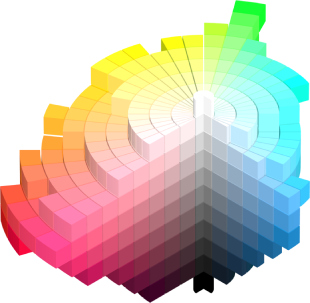
With Newton proving that color was a property of light, people needed a way to describe them without using vague color names. Created by artist and educator Albert Munsell in the 20th century, the Munsell model aimed to create an accurate, standardized, and scientifically proven model of identifying colors.
Munsell viewed colors in three-dimensional space using three different properties, namely Hue, Chroma and value. By assigning numerical values to these properties, Munsell democratized color, making it possible for artists and manufacturers to speak the same mathematical language. His work has been used in documenting artifacts and classifying soil color in the United States Department of Agriculture.
Modern Standardization of Color
As the world became more interconnected through global trade, there was a need for a universally accepted color standard. In 1931, the Commission Internationale de l'Éclairage (CIE) created a framework that took the human element into account. They developed the "Standard Observer," which is a mathematical model that shows how the average human eye perceives color under specific lighting conditions.
This model also allowed for the creation of the CIE Chromaticity Diagram, a map of all visible colors. Today, this standard is what allows a smartphone manufacturer in Asia to produce a screen that perfectly matches the color specifications set by a designer in Europe. It ensures that, regardless of geography, the visual experience remains consistent and professional.
Major Color Models
A color system is basically a system used to describe colors. It helps designers and artists maintain color consistency across different platforms and materials. In design, there are three popular color models, namely the additive system (RGB), subtractive system (CMYK), and Pantone Matching System.
Additive System (RGB)
The additive system is made up of Red, Green and Blue. This system is used for digital and electronic coloring in appliances like televisions, phones, and cameras. This model is very useful to web designers and digital creators as it dictates how your audience will perceive your brand in the digital space.
Subtractive System (CMYK)
CMYK stands for Cyan, Magenta, Yellow, and Key (Black). You can also think of these colors as blue, red, yellow, and black.
This model is also called the “four color” model, and it works by using halftones. Halftones in CMYK printing mean that tiny dots of Cyan, Magenta, Yellow, and Key (Black) are printed in a pattern, and our eyes now see this as one solid block of color.
The CMYK model is also seen as a subtractive model because when its colors overlap, the light wavelengths are absorbed, allowing us to see only the remaining wavelengths that weren't absorbed
The Pantone Matching System (PMS)
For branding, Pantone is the standard color model. This system works by first converting a CMYK code into a spot color, then printing it as a solid color rather than CMYK halftones. However, unlike the CMYK model, the Pantone Matching System has a wider range of colors, including metallic and fluorescent colors.
This system also attaches specific numbers to different spot colors, making it possible for companies to maintain the same brand identity worldwide. For example, using the Pantone Matching System, a company like Coca-Cola is able to maintain the same shade of red on different objects and in different countries, making their branding identical regardless of where you see it.
Color Standards in Industry
Once a design moves from concept to production, there is a need to attain industry standards. These standards are set to ensure that products aren't just aesthetically pleasing; they are also functional and safe.
We can find these standards in industries like manufacturing and product design. Here, it is important that all the products have the same colors because a slight variation could put off customers, lead to the recall of products, re-production, and eventually, huge losses for the company.
To avoid this, companies use spectrophotometers to measure color consistency. This way, every part of a product looks the same, even under different lighting.
In digital and web design, colors aren't just used to make websites look good. Designers now use certain contrast ratios to ensure that even those with color blindness or any form of visual impairment can still view the sight clearly.
In architecture and environmental design, colors are used as a tool for public safety. In traffic, for example, red, yellow, and green are used to signify when and when not to move.
Cultural Meanings of Color
This is the subjective side of color. Color has a different meaning in different cultures, and we can all attach different cultural and personal meanings to different colors.
As our communities gradually become globalized, thanks to technology, it is important to understand the nuances that are associated with different colors in our communities.
For example, in many Western cultures, White is the color of weddings and purity. However, in many Eastern cultures, it is the color associated with death, mourning, and funerals. Similarly, Red is a symbol of luck, prosperity, and joy in China, while in some South African contexts, it can be a symbol of sacrifice and mourning.
These nuances in color symbolism across societies also affect how companies choose colors for globalization efforts. A certain color could mean warmth or confidence in one country, and in another country, it could be associated with ostracized religious or political parties. It is therefore important for professional designers to research and understand the cultural importance of certain colors because failing to understand them could lead to serious branding errors in international markets.
Applications in Communication and Branding
Color is very important in branding and communications because it is the easiest way for businesses to skip logic and speak directly to the customer. By making your product aesthetically pleasing with the right mix of colors, you can get a customer to decide within minutes if they trust your brand or not.
This is the logic that marketing psychology relies on. Color can also be used to provide clarity. It can be used in data visualization to categorize or highlight trends.
In User Experience (UX) design, colors are used to set the emotional tone of an app or digital interface. A banking app might use deep blues and grays to make the user feel secure about their money, while a fitness or gaming app might use high-energy neons and vibrant gradients to create a sense of excitement and movement.
Research Methods in Color Studies
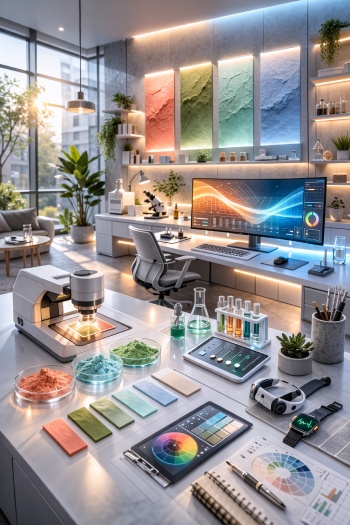
To ensure that the current color standards remain in line with technology and the changes in our cultural landscapes, researchers employ different tools.
One of the most important tools in this field is spectrophotometry. These machines allow researchers to measure the exact wavelengths reflected by a surface, creating a mathematical figure for any given color. A spectrophotometer helps in studying the durability of pigments over time or ensuring that new, sustainable dyes meet the same quality standards as traditional ones.
Researchers also use experimental psychology to study how color affects the human body. This includes monitoring heart rate, skin conductance, and eye-tracking to see how different hues influence stress levels or decision-making speed.
These studies help us understand, for example, why "warm" lighting in a restaurant might encourage customers to stay longer, while "cool" lighting in a warehouse can improve worker alertness.
Also, there are ethnographic surveys which allow us to track the perception our cultures associate with color and if there are any changes over a certain period.
By surveying diverse populations and studying how local communities interact with public art or urban color schemes, researchers can provide designers with up-to-date "cultural maps." These maps prevent design from becoming fitted to just one perspective and also ensure that our visual language remains inclusive and resonant on a global scale.
Future Direction of Color in Design
The future direction of color in the digital world is the rise of AI and adaptive color systems. Currently, we have screens that can adjust their brightness and temperature depending on the time of day.
Our digital screens are no longer static. They can now reduce blue light exposure in the evening and increase hues during the day. These subtle changes help to boost productivity and help reduce burnout. With this new system, color isn't just an aesthetic or form of information; it is now a form of digital medicine.
Color as a Universal Language
Color is more than a choice; it is a universal language. It is a mixture of science, culture, and human emotion. Color has evolved from just being a mystery to becoming an interdisciplinary necessity. Whether you are designing a restaurant menu, building a global brand, or simply choosing an outfit that gives you confidence, understanding color models and principles helps you accurately bring your visions to life.
Given that color influences both the physical and digital aspects of our world, it is important to have standardized systems to help understand how to employ and measure these colors. They don't restrict creativity. Instead, they ensure that our creative visions are translated accurately from the mind to the machine, and finally to the eyes of the viewer.